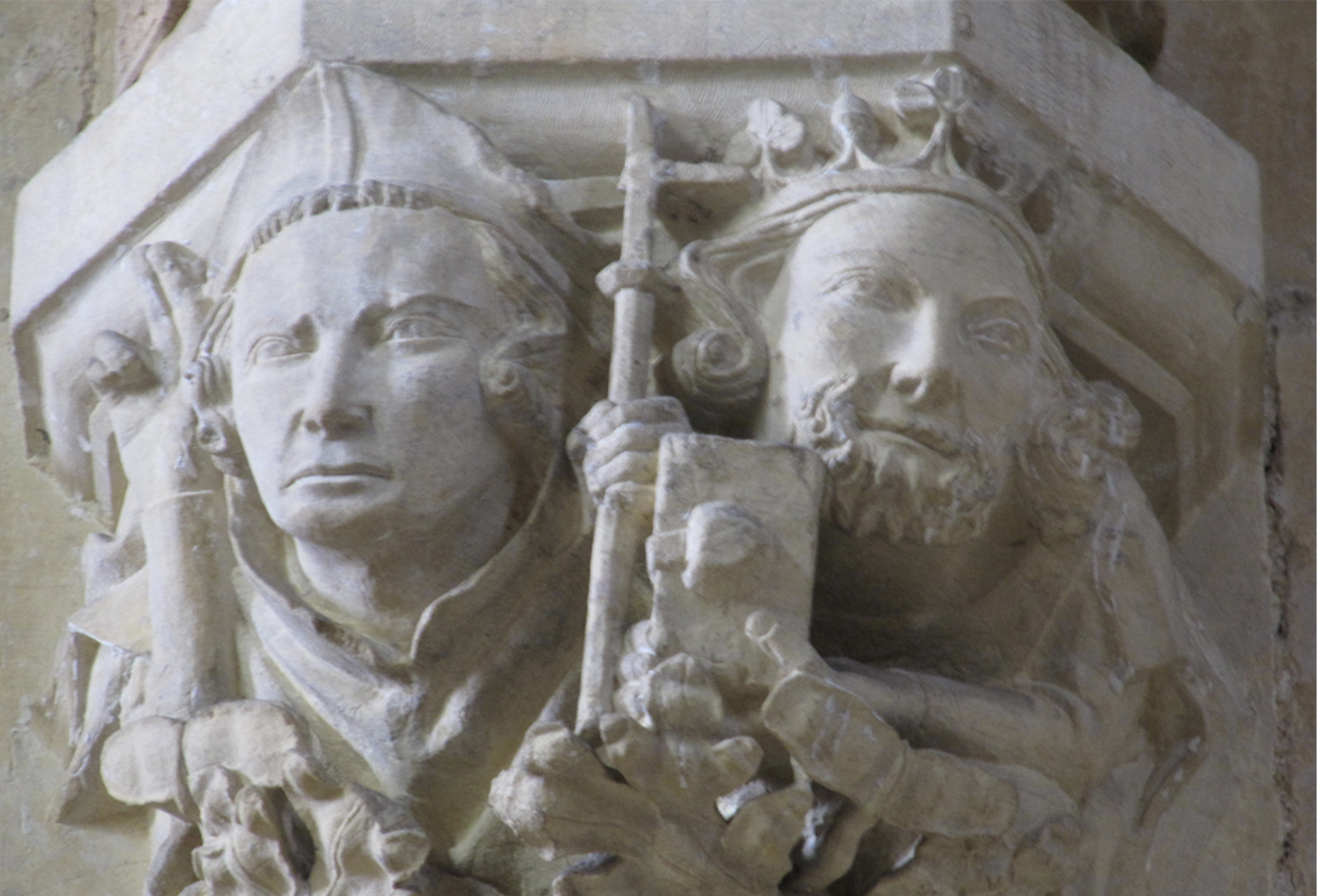
Statue of King Æthelstan in Beverley Minster.
Image from the Beverley Minster website: https://beverleyminster.org.uk/top-10-athelstan/
Brunanburh
Having established the ‘kingdom of the English’ in 927, Æthelstan experienced many threats to its existence. Perhaps the most serious took place in 937 when a coalition comprising: the viking Óláf Guthfrithson; Constanine II, king of the Scots; and Owain, king of Strathclyde/Cumbria, rose up and fought Æthelstan at a place called Brunanburh. Resentment had evidently been building against the English king, and the future of his new kingdom was on the line.
The Anglo-Saxon Chronicle is notably laconic for Æthelstan’s reign, recording the only bare details in its annals. But when it reaches 937, it inserts a celebrated poem—The Battle of Brunanburh—to commemorate the actions of King Æthelstan and his half-brother, Edmund, who successfully fought off the threat that was facing them. A major point of contention concerns the battle’s location, with some forty locations now having been suggested. It is traditionally associated with Bromborough on the Wirral.
No matter where the battle was fought, its significance is undeniable, as shown by the fact that near-contemporary texts from Ireland, Scotland and Scandinavia all take note of its scale and the slaughter that was involved.
Below you can find a modern English translation of the Old English original, in which the events of the battle are related in vivid, poetic detail.
The Battle of Brunanburh poem
Translated by Dorothy Whitelock, in The Anglo-Saxon Chronicle: A Revised Translation, ed. D. Whitelock, with D. C. Douglas and S. I. Tucker (London, 1961)
From annal 937 in the Anglo-Saxon Chronicle:
‘In this year King Æthelstan, lord of nobles, dispenser of treasure to men, and his brother also, Edmund atheling, won by the sword’s edge undying glory in battle round Brunanburh. Edward’s sons clove the shield-wall, hewed the linden-wood shields with hammered swords, for it was natural to men of their lineage to defend their land, their treasure, and their homes, in frequent battle against every foe. Their enemies perished; the people of the Scots and the pirates fell doomed. The field grew dark (?) with the blood of men, from the time when the sun, that glorious luminary, the bright candle of God, of the Lord Eternal, moved over the earth in the hours of the morning, until that noble creation sank at its setting. There lay many a man destroyed by the spears, many a northern warrior shot over his shield; and likewise many a Scot lay weary, sated with battle.
The whole day long the West Saxons with mounted companies kept in pursuit of the hostile peoples, grievously they cut down the fugitives from behind with their whetted swords. The Mercians refused not hard conflict to any men who with Olaf had sought this land in the bosom of a ship over the tumult of waters, coming doomed to the fight. Five young kings lay on that field of battle, slain by the swords, and also seven of Olaf’s earls, and a countless host of seamen and Scots. There the prince of the Norsemen was put to flight, driven perforce to the prow of his ship with a small company; the vessel pressed on in the water, the king set out over the fallow flood and saved his life.
There also the aged Constantine, the hoary-haired warrior, came north to his own land by flight. He had no cause to exult in that crossing of swords. He was shorn of his kinsmen and deprived of his friends at that meeting-place, bereaved in the battle, and he left his young son on the field of slaughter, brought low by wounds in the battle. The grey-haired warrior, the old and wily one, had no cause to vaunt of that sword-clash; no more had Olaf. They had no need to gloat with the remnants of their armies, that they were superior in warlike deeds on the field of battle, in the clash of standards, the meeting of spears, the encounter of men, and the crossing of weapons, after they had commanded on the field of slaughter with the sons of Edward.
Then the Norsemen, the sorry survivors from the spears, put out in their studded ships on to Ding’s mere, to make for Dublin across the deep water, back to Ireland humbled at heart. Also the two brothers, king and atheling, returned to their own country, the land of the West Saxons, exulting in battle. They left behind them the dusky-coated one, the black raven with its horned beak, to share the corpses, and the dun-coated, white-tailed eagle, the greedy war-hawk, to enjoy the carrion, and that grey beast, the wolf of the forest.
Never yet in this island before this, by what books tell us and our ancient sages, was a greater slaughter of a host made by the edge of the sword, since the Angles and Saxons came hither from the east, invading Britain over the broad seas, and the proud assailants, warriors eager for glory, overcame the Britons and won a country’.